

Table of Contents
If you’re the kind of gamer who lives for spreadsheets, emergent systems, and tycoon or management simulation games, you may have already heard of Wall Street Raider, but you could be forgiven if you hadn’t. The cult DOS-era stock market sim has spent almost 40 years in active development, quietly teaching players how markets work by letting them fail, learn, and try again.
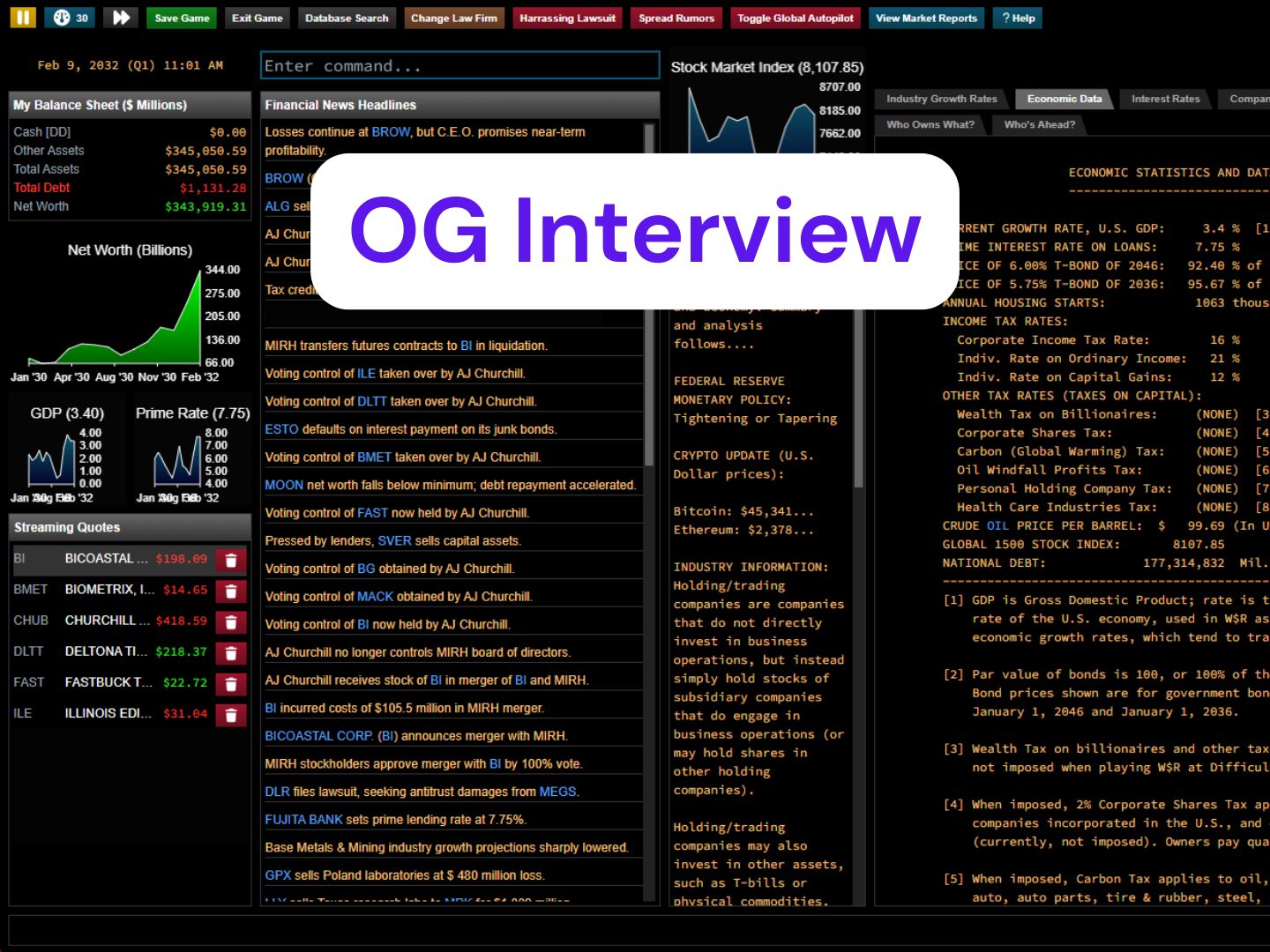
Now developer Ben Ward is rebuilding it for modern PCs while keeping creator Michael Jenkins‘ 40-year-old original simulation engine humming in the background. The result: a thoughtful modernization with a new Bloomberg-esque interface that keeps the hard-won depth that made W$R legendary among systems-obsessed gamers.
This is our second interview with Ben, and our first with Michael. If you want to read more, check out the first interview.
Wall Street Raider is available to play now on Steam as an open playtest. Join the Discord to contribute bug reports and feature requests. For a full transcript of the interview, scroll down to the bottom.
From Board Game to DOS to Now: Jenkins’ 40-years of Development
Before there was a game, there was actually a board. Michael Jenkins began sketching corporate-strategy rules in the late ’60s while at Harvard Law. He was working on a board game with tiny paper stock certificates, a homemade board, and calculator marathons that perhaps only a CPA could love. It was charming…and impossible to sustain. He shelved the physical prototype and kept refining ideas in notebooks, waiting for the day a personal computer could do the heavy lifting.
That day arrived in the early ’80s. Jenkins bought Kaypro (a personal computer from the early 1980s, aluminum-cased 9″ with a green-screen) and used it for work before touching code. Then he cracked open what he calls “Bill Gates’s little short book… on how to write things in Microsoft Basic,” typed a program that said hello, and everything clicked. “As soon as it did that, I realized… this isn’t that complicated,” he says. He stayed up “till like five in the morning, writing all kinds of crazy stuff.” The tools finally matched the ambition.
The finance scaffolding came from real life. Jenkins had Harvard tax classes, a stint as an economist learning present value math on the fly, and high-end corporate tax training at a big CPA firm, taught, at one point, by the person who wrote the IRS consolidated-return regulations themselves. That bled straight into the simulation. Consolidated accounting at 80% ownership? Mergers, liquidations, spin-offs? “I decided… I’ll just build that into the game too and make this thing as realistic as I possibly could.”
Development was, in his words, a “slow drizzle.” He inched into Wall Street Raider over roughly a year after that first BASIC spark, often programming at the office instead of “drumming up business,” then testing, tweaking, and expanding as ideas and edge cases emerged. When money got tight, books he’d published started selling and “bailed me out,” letting the late-night experiments continue.
And then there were the 3 a.m. breakthroughs, the moments when tricky corporate-transaction logic finally snapped into place. Jenkins would push through the night rather than risk losing the thread by morning. “When I look at that code today, I still don’t really quite understand it, but I don’t want to mess with it… it worked right every time.” Forty years later, that stubborn, tested core is still the heart of the sim.
The Big Technical Choice: Don’t Rewrite the Engine
Ben Ward grew up wanting a stock market game with a soul. He could never find anything that was very realistic, or very good. Then he found Wall Street Raider and realized the simulation already had the soul, but what scared more casual players off was the old Windows UI. He also saw the trap that had swallowed earlier modernization attempts: they attempted full rewrites. As he puts it, “What is the thing that all these other… studios tried to do… that is the reason why they failed?… They keep trying to rewrite the code.”
So Ward flipped the problem. “I need to touch as little of the old code as possible,” he says. Instead of porting PowerBASIC to C++ or C#, he created a DLL bridge (dynamic link library) that the original engine could call and then wrote a new front end in C++/Electron. The first proof was humble: “just a button… and some text,” but it demonstrated that this path was going to work. From there, he could “layer on top of the old engine.”
That decision kept Jenkins in the loop. “Now that it’s still PowerBasic… Michael can go in there with the old original version and say, Hey, I just improved this function… and I can just drop it in,” Ward explains. Jenkins noticed the result immediately: “the underlying engine… doing all the calculations for all of the thousand plus companies… seems to be working flawlessly.” In other words, 40 years of balance stayed intact, and development can be parallelized: while Jenkins tweaks the sim, Ward iterates the UX.
It also clarified where bugs live. Ward is candid that “a lot of bugs” reported in the open playtest were “mostly with my code,” with the new UI layer. The engine’s menu-driven flow sometimes had to be extended for direct actions in the interface (for example, selling a specific options contract from a report), and those touch points are where regressions crept in. But the alternative, “upending 40 years of stable code and replacing it with totally unstable code,” wasn’t a risk worth taking.
The bridge approach unlocked visible upgrades the old UI could never do. Jenkins’ reports were static. Unpause and they are immediately out-of-date. Now, Ward’s are “updating live constantly” while the ticker runs. That extra visibility came with honest tradeoffs: during testing, veteran players called the new build slower because the UI was rendering far more data in real time. Ward responded with targeted performance passes (e.g., loading “whatever report you’re looking at” instead of every report at once), and by the time of this writing, that problem has been completely fixed. He has even added clear time progression so players can feel the sim breathing rather than “lagging.”
Under the hood, the architecture is straightforward and flexible by design. Ward runs a local web server between the PowerBASIC engine and the Electron front end, which makes the UI “totally open” to rework and tooling while leaving the core sim closed and stable. It’s a modern wrapper on a proven engine. The result keeps the engine that works, surfaces it better, and lets the original creator keep evolving the system that gives the game its soul.
A Finance Roguelike at Heart
Ward calls WSR a “corporate finance roguelike.” You can memorize mechanics, rehearse openings, even read the entire manual… and still get wrecked when the economy throws something you didn’t see coming. The world isn’t a set of scripted puzzles, but a live market where 1000+ companies tick along on their own incentives while you try to build a strategy. Rate shocks, lawsuits, momentum spikes, scandal headlines, which each run produces, leads to a different chain of events, and the sim won’t bend just because you know the rules.
That’s the hook for Ward: losing is still is highly educational. “Losing is one of the most fun parts of the game because every time you lose, it’s because something you didn’t know was in the game happened and you learned something. This is gold.” He has read “the whole manual” of 300+ pages and continues to be “still terrible,” which tells you how much of WSR lives in practice. Like chess (his comparison), theory gets you to the board, but experience wins the endgame.
Jenkins disclosed that he built an interesting mechanic into the game: a karma counter that quietly tracks your ethics. Pull a cheeky illegal or immoral stunt and the number climbs… keep doing it and the odds turn against you. “You may get away with it a couple of times,” Jenkins says. “Next time you cheat, you’re gonna get busted.” The result is a simulation that lets you play fast and loose but makes repeat offenders pay… eventually.
The tone that emerges is a satire of modern day capitalism. Jenkins wrote event text to echo real-world financial theater. There are press releases, pundit spin, tidy explanations after messy moves, all so you can see the con from the inside. It’s funny until it isn’t, because the consequences are modeled, not narrated. And that’s the roguelike core: the game rewards curiosity and nudges you toward mastery the hard way, through runs that end badly, lessons you can apply to real life, and the next attempt that goes a little further.
How It Plays in 2025: Modern UI, Live Data, and a Community in the Loop
The open beta has a clear pattern: the engine is rock-solid, the UI is still maturing. Ward’s performance work has been iterative, involving cutting wasteful refreshes, loading only the report you’re actually viewing, and smoothing live updates. Jenkins loves the shift. In the classic Windows build, reports were static snapshots, but now you can keep a balance sheet open and watch it tick in real time while the market runs.
Because any deep sim like WSR will hide bugs in unlikely corners, Ward didn’t wait for a perfect build, instead opening the doors to the community so that the bugs could be found and solved faster. The result is a positive feedback loop where veteran players hammer edge cases and ask for switches to suit their style, and Ward responds. Jenkins, too, has a history of honoring that: when a long-time player wanted to test out a ruthless, monopolistic play-style, he added the ability to toggle private and government antitrust actions off. It’s still the same economy under the hood, but with the dials to let you decide how harsh the referee is.
Knowledge sharing is getting the same treatment. Ward is setting up a wiki space because games like Football Manager, RimWorld, and Dwarf Fortress thrive on out-of-game learning and in-game experiments. And he’s building the UI like a website so the surface is malleable. Players can reskin panels, craft custom dashboards, and even script against the running game.
That architecture opens a door for modders: anything you can click, you can automate. Ward notes the server runs on a local port, which means a Python-style bot could read reports and trigger actions programmatically without the UI. Longer term, he wants creators to package “scenario saves” (pre-baked economies with constraints and house rules) so you can load a setup the way RollerCoaster Tycoon shipped challenge parks. Pick your starting position, accept the rule set, press play. The simulation takes it from there.
Strategy Corner: How do the Creators of the Game Themselves Play?
I personally prefer playing a rags-to-riches strategy: start with the smallest stake (a small inheritance of $100 million, though I’d love to see a starting option more akin to my actual net worth), gamble on commodities, and ride the swing. Short the spike on oil, wheat, and corn futures, then buy the dip and wait for reversion to the mean. It works… until it spectacularly does not. Playtesting the new version, having not played in a while, I went bankrupt in literally 3 minutes when a surprise spike in the price of oil wiped me out completely. That’s the WSR experience in miniature: you can have read the manual, predict a “normal” price band, and still get blindsided by the sim’s moving parts.
Michael Jenkins plays a different game. “Find out-of-favor companies that are selling real cheap and that have a good balance sheet. Take those over… get them up to a high P-E ratio, then use the stock to acquire competitors.” It’s classic conglomerate math: a high P/E acquirer absorbing a low P/E target can lift per-share earnings purely through how the accounting rolls up, if you keep the company running well post-deal. His toolkit is the Database Search: screen for low P/E, an industry that’s improving, and a solid analyst rating, then strike.
That acquisition ladder also has a control game baked in. Jenkins notes the real-world playbook from the 1960s. Roll-ups like Gulf & Western would keep industry share near but under the regulatory limits, use the stronger multiple as currency, and then deliberately slow growth to let demand catch up with supply. In practice, the engine will reward that restraint: easing back can boost profitability across the sector, which compounds through your newly combined balance sheets.
Importantly, the sim isn’t “efficient” in a sterile way. Jenkins points out that, like real markets, prices can stay misaligned (overpriced or underpriced) for a while. That’s why his search filters matter. You’re not ever hunting perfect information but filtering for plausible bargains within an improving industry, and with positive analyst views. When the P/E gap and the balance sheet quality line up, the roll-up math starts to compound.
Many styles of play exist for a reason. The engine supports speculative plays as well as a slow-cook compounding game. Futures feed the roguelike side of WSR: quick reads, fast hands, harsh lessons. Jenkins’ fundamental ladder leans more into patience: buy quality at low multiples, improve the business, acquire more with stock. Your temperament will probably decide which you’ll stick with.
And don’t forget the meta. Players routinely discover edge cases the creator didn’t intend, and Jenkins has spent years “plugging loopholes” when these gamey tactics turn into ATM machines.
Closing: A Forty-Year Legacy with Real People in Its Wake
Wall Street Raider grew to become the ultimate simulator of finance and capitalism through decades of late-night code, a manual that doubled as a finance book, and a simulation that just worked. Michael Jenkins barely marketed it, yet players kept finding it, learning it, and writing to Jenkins about their strategies, their wishes for the game, and how it had changed their lives. These were teenagers teaching themselves markets on the demo build, adults crediting the sim with making balance sheets feel navigable, and, in one case, a professional sharing an audited decade of 44% compounded returns after shifting to the low-P/E, turnaround approach he’d honed inside the game.
Ward picked up that torch for a different kind of legacy: continuity. He read the testimonials, saw the impact, and decided the worst outcome would be letting the code fade. His answer wasn’t to rewrite history but to preserve it, keeping the PowerBASIC engine, bridging it, and giving players a modern way to see and interact with it. He’s frank that it’s a labor of love, not a payout, and he frames the Steam release as insurance. Even if something happened to both devs, the build and page remain so new players can still discover the simulation.
Wall Street Raider endures because Jenkins built a world that feels alive and tells the truth about money. And Ward refuses to let that world disappear, while the players keep stress-testing it into something sharper. It’s not a museum piece (even though it probably does deserve a place), but a living market. If it sparks a career in finance, helps make players more financially literate, teaches someone to read a balance sheet, invest more intelligently, or demonstrates that a wipeout is just tuition paid, that’s the legacy: compounding knowledge of capitalism and finance one tough lesson at a time.
Full Interview
Interview is transcribed with light edits for clarity.
AJ Churchill:
Hey, welcome to another edition of the Outsider Gaming Interview. My name is AJ Churchill. Wall Street Raider began in 1986 as a financial simulation game made by a single developer and quietly became a cult classic—part game, part economics and finance lesson, and a ruthless portrait of capitalism itself.
For nearly 40 years, its creator, Michael Jenkins, refined and expanded it line of code by line of code from DOS all the way to modern Windows. And now a new chapter in the game’s history is beginning. Developer Ben Ward is rebuilding the game for a new generation, preserving its complexity while giving it a modern interface and a second life on Steam. Ben, Michael, thank you both so much for being here.
Michael Jenkins:
Great to be here. Thanks, AJ.
Ben Ward:
Great to be here. Nice to see you again.
AJ Churchill:
Good to see you. Michael, can you take me back to the first night that you ever started writing code for Wall Street Raider back in 1986? What did that moment look like? Where were you? What were you thinking?
Michael Jenkins:
I can’t recall what that was. What went before it, though, was years and years—literally starting in, I think, about 1967 when I was in law school at Harvard. I started trying to come up with a board game with corporations, sort of like Monopoly.
After a while I realized this just wasn’t going to be feasible unless someday there were such things as personal computers and I could code it. So I waited and filled up notebooks with ideas for years until about 1983 or ’84 when I finally got my hands on a Kaypro, one of the early personal computers, which had a screen of about five inches, I think.
But it worked. I was using it in my business for a while, but had no idea how to write code until one day I took out Bill Gates’s little short book that came with it on how to write things in Microsoft BASIC. I wrote a little short program that said “hello.”
And that was all. But as soon as it did that, I realized, this isn’t that complicated. So I basically spent that whole night—staying up till like five in the morning—writing all kinds of crazy stuff.
Fake conversations that I could have when somebody would come to my house, sit down at the computer, and it already had stuff about them in it. It was just a hoot. Somewhere after that, about a year later, I realized all along that trying to create something like Wall Street Raider was going to be a major challenge.
So it took me about a year. I just kind of inched into it, so there’s no real start date that I can remember. It was a long gradual process. Once I got started on it, I was finding while I’d be at work—I was practicing on my own at that time—I wasn’t doing very much work or drumming up business. I was sitting in my office programming, trying to create this game. Finally, books that I published started selling, so that kind of bailed me out. That’s how it started—more like a slow drizzle than a storm.
AJ Churchill:
That’s amazing. I had no idea the inception of this game was originally a board game, which I can imagine would probably be the most complex board game with a rulebook the size of, you know, 400 pages.
Ben Ward:
Yeah.
Michael Jenkins:
That’s kind of how it was. I had little tiny stock certificates about this big for each of the companies. I had a big board I’d created and would sit there with a calculator for hours when I was playing with somebody, and finally realized nobody’s going to have the patience to do that.
AJ Churchill:
At that time, did you have the expertise in corporate accounting and how all the mechanics of this game were going to work in your head? Or was it iterative—think of a problem, research how to solve that particular problem?
Michael Jenkins:
Yeah, well, it was kind of like one fed the other. During the years leading up to actually trying to write code for the game, I was going through all the thought processes—what would I have to do to make a merger work? Who are all the concerned parties? How would each have to be dealt with? Same thing for liquidations and all.
Fortunately, I had really good tax classes at Harvard. When I came out, initially I worked as an economist for a couple years with a really good consulting firm that taught me all about present values and a lot about finance just on the fly. Then I went to work for a big CPA firm, and the training there in taxes and really high-end corporate transactions was the best in the world—better than anything I got at Harvard. So I had that going for me. But the whole process of developing ideas for the game also really gave me a huge edge when I practiced with the big law firm and with the big accounting firm, because I just kind of understood intuitively how all this was supposed to work and didn’t have to learn it from the ground up like the other guys coming out of law school.
It was interesting. It just kind of fed on itself. The more I learned, the more I was able to put into the game.
AJ Churchill:
It totally makes sense.
Michael Jenkins:
You know, having played the game a lot—as you’ve probably noticed—I have this concept in there where if one company controls 80% of another, they do consolidated tax accounting. All of that is straight out of the Internal Revenue Code regulations, which are some of the most complicated parts of the tax law.
But I was taught that by the guy who actually wrote the regulations, one of the trainers when I was at the CPA firm. So I decided, hey, I’ll just build that into the game too and make this thing as realistic as I possibly could.
AJ Churchill:
Wow. That’s incredible. I have so many questions, but I want to get Ben in here. Ben, you’re recreating the game for a modern graphical user interface. You’re taking this game that’s so dense and complex in its simulation and translating it into something that’s going to run better on modern computers—and broaden the appeal on Steam for players that are into tycoon and management games. What grabbed you so completely that you felt you had to bring this back? Was there a specific moment where you thought, “I just can’t let this game die”? Where did that arise?
Ben Ward:
I wouldn’t say that Wall Street Raider was dead. People were still buying it—maybe not as much as in the past—but they were still buying and playing it. Online communities had always struggled to stay alive around the game, but people were always still playing it.
What did it for me is I was kind of like Michael—I always had this idea of a stock market game. Not a board game, because I grew up in the personal computing era, but a video game. I thought, “Why hasn’t anyone made a stock market game?” There had been some, but they kind of sucked. I figured I’d make one. I may not have the financial knowledge, but I can Google it. I realized it was a lot harder than I thought. Or I would do it and it looked like the other games—numbers go up, numbers go down—but it didn’t have a soul. It didn’t feel real.
I’d even thought about covering it up with a sci-fi thing. I had this idea called Total Galactic Index—companies on different planets, transporting things between systems. I thought, if I don’t know corporate finance, I’ll make it up—sci-fi finance. But I never had the time to flesh it out.
Then I thought I needed some inspiration—a simulator I could copy some stuff from to get realism. I found Wall Street Raider. It was the only one that I thought was interesting. I didn’t care that the interface was Win32. I was looking at what people were saying. Everywhere on Reddit people were like, “This is the best stock market game ever made.” Then I found your Reddit post, which did it for me. Here’s this guy who’s been working on it for 40 years. It’s niche, and he reached out to me. I was turned on by how detailed his response was. This was a guy willing to give people his time, give a legitimate response, with no expectation. He just seemed like a decent guy.
That was when I had my first kid. I was trying to find ways to stay awake and stay focused, so I was playing Wall Street Raider. I was terrible at the game. Terrible. I thought, “Just like I learned coding by the manual, I’ll read the whole manual and be good at it.” I read the whole manual and was still terrible. That’s when I realized the game has amazing depth. It’s like chess: even if you know all the rules and opening lines, you still need to practice. I got this slogan in my head: a corporate finance roguelike. It’s a game that’s highly replayable and different every time. Even if you know all the rules and mechanics, you still have to practice to get good.
This is gold. Even though I sucked, I was enjoying myself. It’s like Dwarf Fortress. Losing is one of the most fun parts because every time you lose, it’s because something you didn’t know was in the game happened—and you learned. So I just knew: if it had a Bloomberg-terminal-style UI, the entire game is done. It’s just a user interface. The UI probably turns people off, or you have to be a certain kind of person to not care. But the general public might love the mechanics and simulation, and the user experience needs to be modernized. I couldn’t get that out of my head. That’s why I started spamming Michael to let me have a crack at it.
We talked back and forth. Funniest thing: this is only the second time I’ve had an audio call with Michael, and the first time on video. This guy entrusted me with 40 years of his opus magnum, all based on email, sharing info, and me proving through coding and videos that I was the right guy. That’s just crazy. I knew if I could modernize the UI, it would blow up. It still hasn’t really blown up yet, because it’s not done, but I think it will.
AJ Churchill:
I wanted to say it’s not out yet. I’ve been able to play it because it’s currently undergoing an open beta. So, Ben, you reached out to Michael about making this game.
And Michael, I know from a previous interview with Ben—which, by the way, if you’re listening and haven’t seen our previous interview, I highly recommend it—there are a lot of great nuggets in there about making this game happen. Michael, I know that when you received that email, you were probably extraordinarily skeptical. It wasn’t your first rodeo dealing with people who liked the game and had a vision for modernizing it. You’ve said you’ve heard in the past from banks, studios—even Disney developers—who wanted to modernize the game, but it didn’t work out. What made Ben stand out as different?
Michael Jenkins:
Well, at first he didn’t. I figured he was just another guy who was going to take a shot at it and that would be the end of it. I think I may have told him, “Don’t spend a lot of money on this,” because some people spent several hundred thousand dollars on programmers trying to get it to work and they couldn’t. So I kind of forgot about it for about a year—until he came back to me.
Finally he said, “Hey, I figured out how to make this thing work.” That was really exciting, because I had basically given it up for dead. I figured it was so obsolete-looking it was just going to fade into history because no one would ever be able to make it work like it’s supposed to and look like it should.
Once Ben said he had cracked that nut open, I was like, okay, let’s go for it. We came up with a contract quickly.
AJ Churchill:
Nice. You’ve mentioned that a lot of this code came to you in fits of visions at 3 a.m. Developers sometimes say they’ll be working and suddenly figure out in their minds how they’re supposed to do this.
Michael Jenkins:
Yes. Some of the most complex corporate transaction stuff, I remember one of those nights where I went until 3 a.m. because it all kind of fit together. I felt like if I went to bed, I wouldn’t remember how to do this. So I stayed up until I wrote that code. When I look at that code today, I still don’t really quite understand it, but I don’t want to mess with it because I tested it for years and I know it worked right every time. It was that complex—just trying to wrap my mind around it. One of those eureka moments when something you’ve been hammering away at finally opens up.
Ben Ward:
While I was trying to do this over the course of a year, one of the biggest challenges was just learning the language—which is funny because it’s one of the simplest there is. But I was getting in my own way with my professional software training—object-oriented code, classes, properties. Wall Street Raider is actually very simple. Everything has an ID and all the information is in lists. If you want to know how much cash something has, you go to the list of cash values and that ID.
But getting my mind around reading the syntax of PowerBASIC—at first I got the PowerBASIC manual, which was like 2,000 pages. I was rereading the Wall Street Raider manual, which is 300 pages. Over the course of the year I probably spent 90% of the time reading. I wasn’t really coding. I thought, there’s some golden nugget. I was reading the PowerBASIC forums too, trying to figure out how this would work.
I kept thinking: what is the thing all these other studios tried that made them fail? I realized it’s because they keep trying to rewrite the code—PowerBASIC to C++ or some other language—and it doesn’t work. I looked into how professional companies modernize old systems. They don’t rewrite; they keep the code and run it on modern systems. I thought: that’s what I need to do. Touch as little of the old code as possible, replace the user interface, and get that in. That’s when I started making breakthroughs. I realized it’s just a Windows program, with DLLs like C++. I could create a DLL and import it into PowerBASIC, write the new UI in C++. I tried it one day and it worked. I sent Michael a little thing with a button and some text and said, this isn’t anything—but this is it. Now I can use my skills to layer on top of the old engine.
If I couldn’t solve that, we wouldn’t be talking right now.
AJ Churchill:
So is it correct that there’s a lot in the source code you don’t understand—and don’t have to—because Michael did that work? Maybe even Michael doesn’t totally understand every line now. But it’s not important because your job is the translator—the Rosetta Stone—getting his hieroglyphics into a modern GUI.
Ben Ward:
I don’t see it as needing to understand every line. Michael’s been working on it for 40 years. I once sent Michael something I called the Michael Jenkins hypothesis: they’re all different versions of Michael at different points in time working on the game. It’s like clones at different years of his life; their interpretation of how Wall Street Raider works all combines. It seems like there’s a market going on, but it’s Michael at different stages.
I’m sure if he looked at a piece of code, he’d say, I know how this works. I haven’t memorized it. My job is: I see a button, I find where the code is that gets called when you click that button, and I make the new code call that function. That’s all I do. And it still took me two years to figure it out because it’s such a deep game and an old language.
I still suck at the game. I’ve read the whole code and still can’t “beat” it. It’s going to be infinite hours of fun for the rest of my life—if I ever get to sit down and play it.
AJ Churchill:
You should play it; it’s really fun. If I come across a little woozy, it’s because I was playing for about five hours before we started talking.
Ben Ward:
I did sit down and play it. When I sent Michael the first version—which wasn’t very good, but worked—I said I’m going to stream it on Discord. I opened Discord and immediately like 30 people showed up to watch. I did my opening “cheat,” which is: find a company being sued, buy a bunch of calls on the people who are going to be awarded the lawsuit. I played for 20 minutes and made like 10 or 20 billion or something. Then I sat back and thought, my God, it works. It’s fun. This may actually become something after about two years of working on it.
Michael Jenkins:
One thing I’m really encouraged by—though we’ve still got a way to go to finish the GUI—is that the underlying engine that’s in motion all the time and doing calculations for the thousand-plus companies seems to be working flawlessly. It looks like you’ve been able to leave that alone and just tap into it where needed. That’s really encouraging.
Ben Ward:
Yeah. And if Michael wants to improve it—that’s the biggest thing I wanted. If we changed this to C++, Michael couldn’t help anymore. Now that it’s still PowerBASIC, he can go in there with the original version and say, “Hey, I just improved this function; here’s the new one,” and I can drop it in. He still has agency over the engine.
I really haven’t touched it at all. The little pieces I have touched caused bugs that people had to find and tell me about, and I had to fix. Little things like: the old version is driven by menus. In mine, if you have calls, I have a report of all the calls and a Sell or Cover button. I had to tweak the code a little because there’s no function that lets you sell a specific call contract. I programmed that in. Of course it didn’t work the first time; people told me and I fixed it. I can only imagine if I rewrote the entire engine—there’s no way it would work. It would be upending 40 years of stable code and replacing it with totally unstable code.
AJ Churchill:
That’s a really good point, and I’m looking forward to the tariffs update, Michael, whenever you can drop it. Michael, I hold this game in the pantheon of some of the greatest systems-based simulation games ever made—Football Manager, RimWorld, Dwarf Fortress. The kind of game where it’s emergent: the world responds to your actions, but the world is also its own thing. Every game is different because the systems are so deep. That seems like the hardest kind of game to create. It’s a world that just works, right? It feels plausible when the simulation is running. It’s been called the most realistic financial simulator ever made.
But Wall Street Raider also has a kind of moral component—a bit of a moral test. It’s a game where being greedy is a viable strategy, perhaps not unlike real life. Do you see the game as satire, realism, or somewhere in between?
Michael Jenkins:
For me it’s a mixture of all of the above. One of the things that had me up many nights cackling was the text I built in—various scenarios—trying to build in graveyard humor, but realism. So much of it was taken from headlines—latest scandals on Wall Street or in business. “How can I create a scenario for that?” Mostly it was to make it interesting and fun, but also give people a sense of… the fact that so much of what you read, particularly regarding investments, is just BS—stocks being touted for various reasons not always ethical.
In some of the ethical scenarios, you’ll do something, there will be a result, and then you’ll see a headline like you’d see in the real world—except you know the headline is garbage, because that’s not what was happening; you were running a con. I got a lot of fun out of that. But it also teaches. I actually have a karma variable in it. Every time you do something unethical, your karma count goes up. That means the next time you do it, that directly figures into the odds you’re going to get slammed.
You may get away with it a couple of times, but if you keep doing it, your karma number gets so high that you’re not going to be able to cheat anymore. Next time you cheat, you get busted one way or another. So it teaches a little about morality and provides realism about actual morality—or lack thereof—on Wall Street.
AJ Churchill:
How do you feel, as the original creator, seeing players turn your simulation into a way of understanding real markets? There are stories of people who’ve launched finance careers because of it.
Michael Jenkins:
That has really been the most satisfying part. For years I thought of this as a game—my personal obsession and addiction—because I played it myself. If I didn’t have anything else to do, I’d play, see something wrong, or something to improve. It was fun.
About 10 years ago, I started getting emails from people all over the world saying, “I’ve been playing your game since I was 13, living in the Philippines,” or wherever. “Couldn’t afford the full version, so I played the two-year version for years. It taught me so much that now I’m working for Morgan Stanley as a floor trader in Shanghai,” things like that. I started getting more and more of these. People say, “Your game has changed my life.” I go, wow—where did that come from? I had no idea. But I put a lot of love into this thing and I think it’s paid off for a lot of people.
Ben Ward:
That’s one of the reasons I wanted to increase the impact—because of the individual impact the game can have on someone’s life, career, understanding of finance. It’s a game, but everything in it is pretty much real—taxes, mergers. Sometimes it’s just putting yourself in the mindset: if I can do this in a game, maybe I can do it in real life. Maybe I’m not so stupid after all.
If you’re younger, maybe you don’t know what you want to do when you go to college. This game can make you go, “I know what I want to do.” If I can blow it up and thousands play it—it was never about the money. The money’s nice, but Steam’s taking a cut, Michael and I are splitting it, and I could have made more money doing anything else. It’s purely a labor of love to see this thing continue. See what it did for people in 40 years—what if it went on for another 40 and the whole world knew about it?
AJ Churchill:
As I mentioned, I’ve been playing today on the open beta playtest. As of right now, it’s open. If you want to get your hands on this and start sending bug reports, download it and join the Discord—it’s a very active community. Ben, now that the game is available for playtesting, what kind of feedback are you receiving? What’s the response been?
Ben Ward:
It’s a mix. A lot of bugs—but mostly with my code. There are no bugs really in the old code. Some of the older players are very used to the old version. They’ll say, “Your version’s slower,” which I fixed. I don’t know if it’s as blazing fast as the old one, but you also have to consider: my version is showing a lot more on the screen than the old version. It may be slightly slower because it’s generating what used to be separate reports in real time as you run the game.
I’m about to release a performance update. I found a couple issues that will really speed it up and make it smoother. I also changed things like: if you’re looking at a report, before I was loading all the reports for that company. I didn’t realize how laggy that was. Now, whatever report you’re looking at, it just loads that report.
Michael Jenkins:
That’s one of the real nice innovations Ben has put in. Before, things like earnings reports or balance sheets were static. If information got updated while you were watching, what you were looking at on the screen was already out of date while the ticker was running and everything else was changing. Ben has it updating live constantly.
Ben Ward:
You just have to iterate and keep improving. You asked how the simulation is so stable and balanced. As someone who’s tried to make simulation games, it’s not easy. I think Michael has solved it through time—continuously playing it, finding a little thing, fixing it, layering balancing code on top. A lot of games try to do a lot in a short time; Michael took his time to do it right.
Feedback from the community: lots of complaints about bugs and lag and different things—but they’re still playing it. On Steam stats, a lot of people open it, look, and close. But the graph shows increasing playtime; some people have 30, 50 hours already. That’s who I want to hear from—people like TrimBarkTree or Malor on the Discord. They’re my core people. I want feedback from everybody—there’s a bug report channel, a suggestions channel. I pick the highest-impact things for the next sprint. I pay attention to older players because if I can make them happy, I can make everybody happy.
With new players, it’s a hard learning curve. Before, you’d have to buy the manual. I’ve been talking to Michael and now the Steam version is going to sell for what you would have paid for the game and the manual. Instead of packaging the manual, I created a wiki—wallstreetraiderwiki.com. Over time, hopefully it will get all the knowledge and strategy, not just from the manual but from veteran players. All kinds of complex games—Dwarf Fortress, Minecraft, RimWorld, Football Manager—have a wiki. There’s no real tutorial; the manual is a reference. So is the wiki.
Overall, I think it’s been positive.
AJ Churchill:
I think you hit the nail on the head. It’s not a game for everyone. It looks like a Bloomberg terminal. There’s a natural group of people that just won’t be interested. But for those who like “numbers go up” games and want to imagine themselves as financiers, business leaders, multi-billionaires—rags-to-riches stories—I think they’re going to enjoy it. It’s addictive. I played it for five or six hours today.
Ben Ward:
When I did the playtest, I was originally going to give keys individually. I forced them to fill out a marketing survey—what games they like, age, interests, favorite games, what they like about WSR or the old version. You’d be surprised: people who’ve played this game a long time play all kinds of games. There’s no one genre—MOBAs, RPGs, roguelikes, wargames, tycoon games, shooters. Something about Wall Street Raider taps into something they don’t get from other games. I think it’s undetermined how many people would be interested. We’ll only know once everybody knows about it. That’s my second phase: first, get it to early access and stable; second, tell everybody about it.
Michael Jenkins:
That’s going to be a big change. My approach over the years has been to just put it out there and hope people find it. I’m like the world’s worst marketing person—no clue how to do it. I even tried running ads a couple of times and got zero response.
Ben Ward:
I think we’ll see. Everybody’s playing Wall Street Raider, but the most fun for me is I’m playing a different game in real life—as a software engineer, probably a little on the spectrum, ADHD. I didn’t know much about marketing or product-market fit. Working on WSR taught me that. What they teach about marketing is simple: any kind of marketing works with a great product; marketing doesn’t work with a terrible product. The general rule is: first focus on the product. Michael focused on the product for 40 years. It’s perfect. Now we focus on marketing. The UI is part of the marketing—the sexiness of it. I’m focusing on that.
AJ Churchill:
So that brings me to the next point, Michael. Once the new GUI is out and the game is for sale on Steam, do you see yourself going back in and adding new features, or is your legacy set and you’ll watch the rebirth?
Michael Jenkins:
I’ll probably make a few tweaks from time to time—I can’t quite take my hands off it. In the last version I had put just about every category of financial instrument I knew anything about. I felt pretty complete at that point. I was ready to retire and watch it fade into the sunset until Ben came along and decided it was possible to keep it going with a new face.
AJ Churchill:
Are there any features you’d be interested in implementing in the future?
Michael Jenkins:
I’ve gotten tons of wild suggestions over the years—making it more like Dungeons & Dragons, role-playing elements. To me that’s a departure from the hard financial game it was intended to be—the idea was to make it as realistic as possible, but still fun. I’m probably not going to embark on major changes. But Ben will probably come to me with ideas for improvements I can work on, which I’ll be glad to do. I enjoy writing code. BASIC is pretty much pure logic. That’s what I loved about it. It’s the only computer language I’ve ever learned.
Ben Ward:
I don’t think you’ll ever fully take your hands off it. Every little thing I tell you—like there’s this one guy, Malor, with a lot of opinions, but they’re good. He’s obsessed with the game. A lot of ideas for improvements and bugs he’s found that nobody else found. One thing he kept asking for: a cash flow statement for banks. He kept hammering it. I wondered how that would even work—the deposits are always changing. You Google how banks manage that, it’s complicated. I messaged Michael: is this even a thing? Michael said, “I don’t think that’s a very good idea; not sure how useful that report would be, and it would be really hard to do.” It was kind of dead. Then two days later, I get an email from Michael: “I think I figured out how to do cash flow statements for banks.” So once either of us gets an idea, we have to sit down and code it.
AJ Churchill:
My bank just passed $100 billion in market cap. I also noticed there’s no cash flow statement for banks. I’m waiting for that one too.
Michael Jenkins:
It’ll be in there. I’m still not sure it’s very useful, but if people want it, might as well give it to them.
Ben Ward:
It’s like crypto too. People asked for crypto for years. Michael added it. He’s not sure how useful it is, but it’s basically a commodity—a very sporadic, more random commodity. Sometimes people just want stuff in the game because it makes it feel more realistic. “It’s even got crypto. It’s got oil. It’s got everything.” How good of an investment it is is a different question, but the fact that it’s there matters.
Michael Jenkins:
People hammered away at me for several years on crypto. I eventually gave in. I put it in, with futures as well. In my other game, Speculator, I even created a couple of ETFs for Ethereum and Bitcoin.
Ben Ward:
People are constantly asking me about Speculator. Relentless. “Is Speculator going to be a game mode?” I’m thinking, what is it about Speculator? In Speculator, it’s kind of like you have to build up and unlock financial instruments. You start with a little money, build up, and then at certain amounts you unlock instruments.
Michael Jenkins:
Right—your broker won’t let you sell short or buy on margin at first. As you hit benchmarks, you get approved, which is like the real world.
Ben Ward:
I think that’s why people like it—the progression. From a design standpoint, it’s like a tech tree. That’s something I’ve thought about—how to, instead of letting you use any instrument, force you to master instruments by making them unlockable, starting with simpler ones. Over time you get to use riskier, higher-payoff ones. I’m not sure we need to implement Speculator fully—maybe build in progression and make it optional. Any time you add something, half the people say, “Great,” and the other half say, “Make sure I can turn it off.” People love their flavor of the game.
AJ Churchill:
Speaking of playing the game my way—this is where I want to pick your brains. I find myself falling into the same strategy every time. I want to break out of that, but I’m set in my ways. I found a way that works to make a ton of money: I start with the lowest amount possible because I love the rags-to-riches story—small inheritance of $100 million. Then I speculate in futures—particularly oil futures—short selling or buying futures in corn or wheat. Silver is okay early but the game lets you buy such a small amount that I can’t make much. I know generally how much wheat, corn, and oil are “supposed” to cost. If corn goes over a threshold, I short; then I wait for it to swing down, sell; then do the opposite. It works well, but I’m stuck in that mode. I did this for five hours today.
Michael, how do you play the game? What’s your strategy?
Michael Jenkins:
I use a lot of different strategies, but generally: find out-of-favor companies selling cheap with a good balance sheet. Take those over, try to build them up so they generate nice earnings and the P/E ratio goes up.
If I can get them to a high P/E, I’ll start using the stock to acquire competitors or even companies in other industries that are cheap. You get an interesting effect—which is a real-world thing—when you combine the accounting of two companies in a merger. If the acquiring company has a high P/E and it buys a company with a low P/E, you put those two together and the net per share (assuming earnings stay the same) goes up for the surviving company. That’s how the accounting works. In the 1960s, companies like Gulf & Western did this—conglomerates buying boring companies selling at six to eight times earnings when they were at 20. Every time they did that, their net earnings would go up automatically—if they could keep the companies from falling apart. Most mismanaged what they took over, so in the long run it didn’t work out. But it’s an interesting short-term tactic.
It’s also a way to take control of an industry—keep close to 50% market share so you’re not getting hammered by antitrust suits, cut back growth, boost profitability of the whole industry when you slow growth and let demand catch up with supply.
AJ Churchill:
What’s your stock screener? What metrics do you use?
Michael Jenkins:
I use the database search. It’s handy for looking for low-P/E companies with certain characteristics—an industry that’s improving, a high analyst rating. I’ll build in factors and look for a target that seems favorably priced. The algorithms are inefficient enough that, like the real world, there are bargains to be had—and stocks that are definitely overpriced, though they may stay that way for a while.
AJ Churchill:
Ben, do you have any favorite strategy—or interesting ones from legendary players testing the beta?
Ben Ward:
Like I said, I’m terrible at playing the game. I’ve spent 99% of my time coding it. I probably know the engine and rules, but in terms of actually playing, I don’t have a lot of experience. For example, banks—I don’t know how to run a bank in the game.
So I’m going off the pulse of the community. If they ask for something—like recently, “Insurance companies: you forgot to add the button to buy subprime mortgages”—I go look and, yeah, I forgot that button because I’ve never used it. I’m at the service of the community—coding, marketing, curating ideas.
Michael Jenkins:
One of the funny things: even though I know every line of code and I’ve worked on it for 40 years, I don’t play it nearly as well as a lot of players. I get people telling me, “I got to 300 quadrillion in only two years of play,” and I think, how in the world? People are so darn smart. It’s like I’ve been playing chess against the world. I’d put out a new feature and, sure as hell, before long somebody would tell me, “I found how to make trillions overnight with that new feature.” I’d say, uh-oh, I have to fix that—it’s too easy. I felt like the IRS plugging loopholes: can’t have loopholes that are too easy.
Ben Ward:
Mark Clipknot is probably the worst (or best) at doing that—and then posting a video about it.
Michael Jenkins:
Yes. He would kind of get angry at me.
AJ Churchill:
Can you explain what he did?
Ben Ward:
For example, bond cancellation—which I honestly don’t entirely understand how he did—it doesn’t really work anymore. It still kind of works, but Michael would probably be better.
Michael Jenkins:
I had to do a lot of tweaking so you can still do that, but for a while it was open season. He’d do it in videos with spreadsheets—go down the line, one company after another, take it over, recapitalize, easy money—too easy.
Ben Ward:
People wonder: I released it for playtesting and there were bugs and lag. Somebody on Reddit was really mad and said, “It’s like you didn’t even play the game. You didn’t test it yourself.” And… I kind of didn’t. Why do you think I released it and let thousands play it? It’s so complex and I barely understand how it works anyway. I got flooded with bug reports and suggestions; I schedule fixes and work on it. That’s faster than me trying to test everything. I would never have found those bugs playing myself. I’ve probably gotten so many man-hours of testing for free by letting them play for free. My hope is that when I claw back the playtest and you have to pay to play, they’ll still pay. They won’t be bored. They will have played hundreds of hours and still give Michael and me $30. That’s my bet.
AJ Churchill:
They will. Having just come out of five or six hours of playing myself, I keep going back. You’ve created a world you can step into and lose yourself for hours—it’s actually a little scary.
Ben Ward:
Someone told me, “You need to add the real local time in the game.” So I added that. But people kept saying the game was slow or laggy. Not every tick produces a news headline, so there was a gap in feedback. After fixing the lag, I realized every day in the game is a certain number of ticks—about 16–17 ticks. Markets are open 9:30 to 4. I divided that by 16–17, and now the time in the game updates every tick. You can see market open and time moving every tick—if you have it on full throttle. If I implement full screen and your system clock is hidden, that might be bad for people—they’ll totally lose track of time.
AJ Churchill:
Well, that’s the danger—you created a product that’s too good. Michael, I want to talk about the legacy of Wall Street Raider. What do you hope people will remember about the game—or about you?
Michael Jenkins:
I hope people will be grateful, and the main legacy—other than hours of enjoyment—will be that they got something from it that helps them manage their finances better, invest better, or even leads to a career in finance. I’ve had many people tell me that as kids they weren’t sure what they were going to do; they started playing and got hooked on the idea of being in finance and turned that into a career.
I’m definitely not Ben Graham, but I had an email from a young guy who runs a successful hedge fund. He said he’d played for years and noticed that buying cheap companies—low P/E and turning them around—seemed to be very profitable in the game. He wasn’t doing that with his clients; he wasn’t doing well. He decided to start doing what he’d been doing in Wall Street Raider. He sent me an audited report from, I think, PricewaterhouseCoopers—ten years of trading where he averaged a 44% compounded rate of return, signed and dated by a partner. He said it was because he found what worked in WSR and tried it in real life. That change made all the difference.
I hope there are a lot of people out there who may not know who I am—but if they get a lot of chuckles when some strange scenario pops up and they find it totally appropriate and funny, that’s a real positive. Just to make people laugh—laughter’s good for you.
AJ Churchill:
I think this game does a great job demystifying a lot of actions you can take in the financial world. It makes looking at a balance sheet less scary, earnings less scary. It’s a low-stakes playground. Even if I get wiped out because the price of gold went down two percent, I learned something and don’t have to sell my house. It’s great for that.
Ben Ward:
Responsibility… In the last interview I said I try not to think about it. It’s pretty scary. I’m kind of a perfectionist, which makes it hard to succeed in business—you can’t be a perfectionist; you have to be good enough and keep failing forward. When I play WSR—which is probably why I’m not good—I try to read the manual thinking that’ll make me better. I’d be lying if I said I didn’t think getting the code would make me good. Nope. It’s all about practice and experience.
I’ve got it to the point now where it’s kind of out of my hands. I’m accountable if it’s a disaster—I’m the scapegoat—but I think it’s at the point where it can’t really fail. If a business isn’t growing, it’s dying, so you have to keep improving the product—as long as you don’t run out of money. I don’t have that issue because it’s not my full-time job. Like Michael said, don’t waste hundreds of thousands of dollars, and I haven’t. I’ve probably spent a thousand dollars on art and things—which seems like a lot—but I take the presentation seriously. Steam graphics: I paid a professional. Achievements: we’re going to have probably the best achievements graphics on Steam.
One reason I wanted it on Steam is that, let’s say a freak accident happens and Michael and I both get hit by a bus—WSR will still live on, so long as Steam doesn’t take the page down. It will go on forever. It doesn’t really depend on Michael and me anymore. But as long as we’re alive, we can work on and improve it. I couldn’t say this last time, but I think I’m doing an okay job now.
Michael Jenkins:
Just to add: I haven’t tried to put pressure on Ben or make him feel like he has to succeed or I won’t be able to pay my rent. I’m well set financially; I’ve invested well. If this goes and Ben takes it to new heights, I’m enthused. If it turns out it’s not going anywhere—well, that’s it. It’s been fun. If there’s pressure on Ben, it’s probably from people wanting him to finish this and make a great game—make my old jalopy look like a Ferrari.
Ben Ward:
I’ve had a weird sense of purpose from working on this, which I didn’t expect. Originally it was just a technical challenge. It ended up being the most difficult technical challenge of my life—number of problems, things I had to learn and read about—not just programming but finance.
But I’ve gotten a sense of purpose because of the economic mobility the game can impact. Michael said a trader took strategies from the game and got way above-average returns. If that isn’t testament that the game is realistic, I don’t know what is. The CEOs and investment bankers who got into the career and transferred knowledge into success—if that isn’t testament to the educational value, I don’t know what is.
That’s a huge moral responsibility. People in poorer countries taking this game and changing their economic mobility—it’s a huge moral purpose to make sure it gets to as many people as possible. After splits and fees and taxes, if I make a couple bucks per copy—it doesn’t matter. My main metric is: is the original simulation preserved? Is it presentable to a modern audience so people who otherwise wouldn’t play will now play because it looks different? I want to get messages ten years from now: “I was 13, found this on Steam, started playing, and now I’m a CEO; it changed my life.”
It’s up there with meaning in life. I get most of that from family, but pretty high up is Wall Street Raider. Earlier you asked what made it so I couldn’t let this die. I saw the testimonials page. I read every single one. Once I read that page, I thought: there’s no way I can let this become abandoned. Even if Michael never gave me the source code, it would have taken longer, but I probably would have done something like reverse-engineering—like they did with RollerCoaster Tycoon. Thankfully, Michael gave me the code and saved a whole bunch of time.
There’s a huge sense of responsibility—keeping this thing alive and letting it continue to impact people, not just for entertainment but educationally and economically.
Michael Jenkins:
Just one word of warning: it will take over your life.
Ben Ward:
It already has. I can’t escape. I thought the other day, “I could turn the Discord server off and the Steam page off. Nobody knows where I am. I could disappear.” Obviously I would never do that. But I feel the pressure from the community: “When’s the next update?” The silence is deafening—thousands of people watching me: what’s next, when will you fix that bug? Sometimes someone’s entire strategy depends on one thing, and he’s mad. That’s pressure: “Sorry, Kara—my wife—I’ve got to stay up tonight.” We’ll watch Jeopardy! and then I’m up till one or two fixing this bug, because otherwise he’s not giving Michael and me $30.
Malor is one of the biggest pressures in a good way—perfectionism. He’s constantly telling me, “If you don’t fix that, I’m not buying the game.” I go through all the emotions—but it pushes me to make it better.
Michael Jenkins:
You eventually give in to those pressures. You’ll get someone insistent and think, that’s a crazy idea. A couple of years ago a guy said, “I love the game, but I hate these darn antitrust suits. Every time I try to take over an industry, I get hammered. Why can’t I turn that off?” I finally gave in. Now there’s a feature where you can turn off private antitrust suits, government ones, or both. Then it becomes like the robber baron days—no limits on monopolies—and you can build to 100% of an industry and be incredibly profitable. It’s giving people what they want and need to play the game well.
Ben Ward:
The cheats thing is big—it’s a sandbox. If you want infinite money, fine—you can explore all aspects of the game. TrimBarkTree was asking to make it easier to load a previous game so he can save-scum. In any game with randomness, some people reload until they get the outcome they want. They find entertainment in that.
That’s one reason I’m doing modding. We didn’t get into the technical challenges of the UI, but essentially every UI decision has been so that, at some point when it gets big enough, technical people who like to mod games can come in. I want to give them the freedom to do what they want. The engine isn’t open source, but the new UI is—totally just text files; it’s websites. It’s using Electron—a web browser pretending to be a desktop application. I have a web server running between the old engine and the new UI. It’s a website running on your local computer, hitting this server that talks to the old engine. That’s where a lot of the lag came from, but I’ve solved a lot of it.
Because it’s on a port, you could write an AI or a trading bot. I want people in the quant field to build bots interfacing with the engine directly—without the UI. Anything you can do in the UI, you can do programmatically—write a Python program, get all the reports, click any of the buttons. I’m hoping AI and quant people take this on. I want modability—save custom information to a save file so they can not only change the UI, but save their own custom info to the game. You could build logic of mods into the UI without needing the back part.
I’ve imagined scenario saves—improving save/load so people can build scenarios like RollerCoaster Tycoon did with landscapes. “Here’s the landscape—build a theme park.” I want that for WSR: here’s where it is, and certain options are disabled, others enabled. Like Football Manager: a base game that’s the heart of it, and people build different flavors on top, so this thing never goes away—big community, serving all kinds of interests and ways of playing.
AJ Churchill:
I think few games stay relevant for four decades. In your hands, Ben, this game could stay relevant for another four decades—based on Michael’s work and what you’re doing now.
I love the game. I’ve always loved it. I like that there’s an amazing UI where I can see graphs, click links, get places faster, and implement strategies. It’s fantastic. It’s so easy to lose yourself in this new version. I’m excited to keep playing and see the updates. On my question about pressure: Ben, I think you’re doing a fantastic job. Having played what felt like 10 minutes—but was actually five hours—everything you’re doing is working, based on the 40 years of effort Michael put in. Thank you both so much for speaking to me for Outsider Gaming.
For those still listening, please like and subscribe, and leave a comment—it really helps us increase visibility. Share this interview with your friends, and I look forward to hearing the stories of your raiding. Thank you both so much.
Michael Jenkins:
Thanks for having us on. We appreciate it, AJ.
Ben Ward:
Thank you.